TL;DR
Answer engine optimization helps startups become quotable sources in AI answers, not just blue-link search results. The lean path is to define entities clearly, publish answer-first pages, add evidence, and make content easy for LLM crawlers to understand.
AI search is changing discovery faster than most startup content calendars can react. Answer engine optimization for startups means shaping a young company's website so Google AI Overviews, ChatGPT-style assistants, Perplexity, and other answer engines can identify, trust, and cite its pages. Earlyseo helps founders treat this as a visibility system, not a one-off content trick, especially when paired with an Earlyseo llms.txt workflow.
Table of Contents
What is answer engine optimization?
Answer engine optimization is the practice of structuring website content so AI answer systems can extract clear, accurate responses and cite the source. It overlaps with SEO, generative engine optimization, and content strategy, but the main goal is not only ranking. The goal is being selected as an answer.
Answer engine optimization: a content and technical process that makes a company's facts, explanations, comparisons, and proof easy for AI-powered answer systems to understand and reference.
Traditional search engine optimization, as commonly defined in sources such as Wikipedia, focuses on improving visibility and performance in search engine results pages. Generative engine optimization focuses on visibility inside generated AI responses. AEO sits between both: it keeps classic discoverability while making content easier to quote.
Key insight: a startup does not need thousands of pages to compete in AI answers. It needs a smaller set of pages that define the company, the category, the product, and customer problems with unusual clarity.
AEO, SEO, and GEO compared
AEO works best when it sits beside SEO and GEO rather than replacing them.
| Practice | Primary surface | Startup objective | Best content format |
|---|---|---|---|
| SEO | Google and Bing results pages | Earn rankings and organic clicks | Guides, landing pages, category pages |
| AEO | AI Overviews, assistants, answer boxes | Earn citations and direct answers | Definitions, FAQs, comparison tables |
| GEO | Generative AI responses | Shape how models summarize the brand | Entity pages, proof pages, structured resources |
| LLM SEO | LLM crawlers and retrieval systems | Make content machine-readable | llms.txt, clean HTML, concise summaries |
Research on explainable AI by Hassija, Chamola, and Mahapatra in Cognitive Computation reviews why black-box model behavior can be difficult to interpret, which matters for AI visibility measurement because citation selection is not fully transparent (study PDF).
Why should startups care early?
Startups should care early because answer engines reward clear entities, focused expertise, and well-structured proof before a brand becomes famous. Large brands still have authority advantages, but younger companies can win narrow, high-intent answers by being easier to parse.
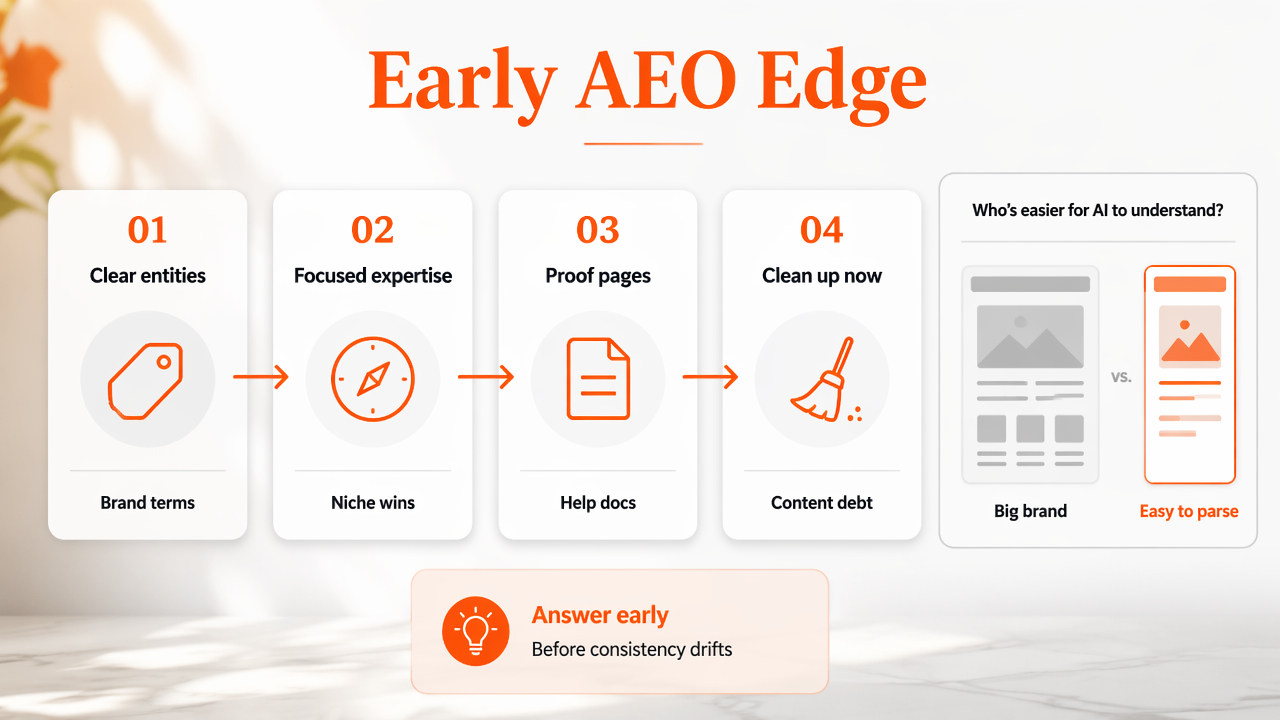
Founders often wait for classic SEO traction before investing in AI visibility. That delay creates a content debt. Product pages, help docs, comparison pages, and founder-led explanations become harder to clean up once inconsistent terminology spreads across a website.
A lean startup can gain an edge by answering questions that big competitors ignore:
- What problem does the product solve in one sentence?
- Who is the product not for?
- How does the workflow compare with manual work or legacy software?
- What integrations, data sources, or formats does it support?
- Which proof points are public and verifiable?
Early-stage content should also make the company's entity graph obvious. A crawler should understand the brand name, product category, audience, pricing model, locations served, and related tools without guessing.
Startup pages most likely to earn AI citations
The strongest early AEO pages answer specific questions with stable facts.
| Page type | Why answer engines like it | Startup example |
|---|---|---|
| Definition page | Gives a direct explanation of a category | "What is AI invoice matching?" |
| Comparison page | Helps summarize tradeoffs | "Product A vs spreadsheets" |
| Alternatives page | Maps competitors and positioning | "Best tools for local review monitoring" |
| Use-case page | Connects audience, problem, and workflow | "SEO reporting for Shopify stores" |
| Integration page | Gives concrete compatibility details | "Connect analytics to WordPress" |
A startup with a CMS-heavy website can reduce publishing friction through the WordPress integration. E-commerce teams can do similar work through the Shopify integration, especially when product descriptions and collection pages need clearer answer-ready copy.
How should a startup build an AEO plan?
A startup should build an AEO plan by choosing one narrow topic cluster, writing direct answer blocks, adding structured evidence, and tracking whether AI systems repeat the same facts accurately. The plan should be small enough to ship in weeks, not quarters.
- Define the core entity. Write one approved description of the company, product, audience, and category.
- Map real questions. Use sales calls, support tickets, search queries, and competitor pages to find questions worth answering.
- Create answer-first sections. Start each section with a sentence that directly answers the heading.
- Add proof. Include screenshots, public documentation, customer examples, pricing facts, and integration details where available.
- Use structured formats. Add tables, definition lists, FAQs, and short numbered steps.
- Expose crawler guidance. Publish clean HTML and consider an
llms.txtfile for AI-oriented navigation. - Review AI outputs monthly. Check whether answer engines describe the product accurately.
Earlyseo fits this workflow when a small team needs to organize AI-readable pages without turning content operations into a full agency project. The platform's broader LLM visibility guidance can help teams connect AEO basics with crawler-facing signals.
Lean AEO checklist for the first 30 days
A practical first month should focus on pages closest to revenue.
- Publish or rewrite the homepage with a clear category sentence above the fold.
- Add a glossary-style definition block to the main product page.
- Create one comparison page against the status quo, such as spreadsheets, agencies, or manual work.
- Add FAQ sections to the top three commercial pages.
- Mark up important pages with simple schema where appropriate.
- Build one integration or use-case page tied to a high-intent audience.
- Document preferred wording in an internal content guide.
Reproducibility matters because AEO work can become messy across tools and teams. The Snakemake paper by Mölder, Jablonski, Letcher, and others discusses reproducible data analysis workflows, a useful principle for repeatable SEO and AI visibility reporting even though the paper is not about marketing (F1000Research article).
What content formats win AI citations?
AI citations tend to favor content that can be lifted into an answer without heavy interpretation. A strong page explains the concept, names the audience, shows the tradeoffs, and provides facts in a format that a retrieval system can separate from fluff.
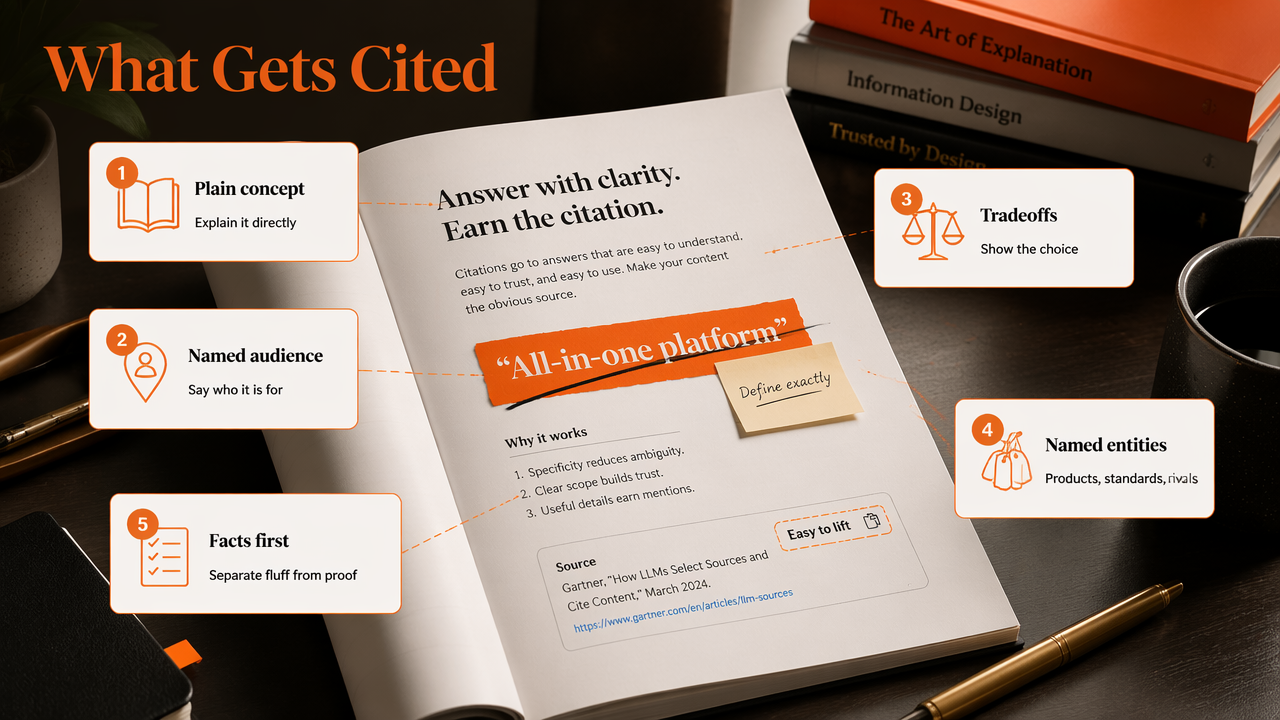
The best startup content sounds plain. It avoids vague claims like "all-in-one platform" unless the page explains exactly what sits inside the platform. Named entities matter: product names, categories, frameworks, locations, integrations, standards, and competitors help answer engines place a page in context.
AEO-friendly writing also uses consistent terminology. If one page says "AI receptionist," another says "virtual phone agent," and another says "voice automation," an answer engine may struggle to connect them. A public glossary or terms page can reduce that ambiguity; Earlyseo's SEO terms resource shows how definitions can be kept concise and extractable.
Citation-ready content blocks
Several content blocks are especially useful for startups trying to win answer visibility.
- Definition block: one sentence that defines the concept without hype.
- Who it is for: a short audience list with clear fit and non-fit signals.
- Comparison table: a neutral breakdown of options, tradeoffs, and use cases.
- Step list: a numbered workflow with one action per step.
- Evidence block: links to docs, integrations, case studies, or public product details.
- FAQ block: 3 to 5 questions that match buying objections and research queries.
Strong AEO pages do not try to answer every possible question. They answer the right question cleanly enough for an AI system to reuse the answer.
The Earlyseo platform is most useful when these blocks need to be rolled out across many startup pages without losing consistency. For ongoing publishing, the blog management area can support a steady cadence of answer-first articles and updates.
What will change in 2027?
AEO in 2027 will likely become more technical, more evidence-driven, and more tied to brand consistency across the open web. Startups that build clean entity foundations in 2026 should have less cleanup work as AI search systems become more selective.
Three shifts already look likely. First, AI assistants will keep blending search, browsing, and task completion, so citations may appear inside workflows rather than classic search pages. Second, answer engines may rely more on source freshness and structured page summaries. Third, brand mentions outside the company website may matter more because models compare claims across sources.
Academic work on emerging digital systems, such as the 2022 multidisciplinary paper by Dwivedi, Hughes, Baabdullah, and coauthors on metaverse research and policy questions, shows how fast new digital interfaces can create business, governance, and trust challenges (International Journal of Information Management). AI search is following a similar pattern: adoption moves faster than measurement standards.
Startup teams should prepare by keeping pages factual, dated where useful, and easy to refresh. earlyseo.com should be checked when a founder needs a practical way to turn that habit into a repeatable publishing workflow.
Metrics that matter more than vanity traffic
Classic organic sessions still matter, but AEO needs a wider scorecard.
| Metric | What it reveals | Review cadence |
|---|---|---|
| AI citation presence | Whether answer engines reference the brand | Monthly |
| Answer accuracy | Whether summaries describe the product correctly | Monthly |
| Branded search lift | Whether AI exposure creates brand demand | Monthly |
| Assisted conversions | Whether informational pages support pipeline | Quarterly |
| Content freshness | Whether key pages still match the product | Monthly |
One common misconception deserves a clear answer: AEO is not a shortcut around authority. A startup still needs useful content, credible proof, and a technically accessible site. The difference is that answer-ready structure can help that proof travel further.
FAQ
Answer engine optimization raises practical questions for founders, marketers, e-commerce operators, and local businesses because the channel sits between SEO, content, and AI product discovery.
Is answer engine optimization the same as SEO?
Answer engine optimization is not the same as SEO, although the two overlap. SEO focuses on visibility in search engine results pages, while AEO focuses on being selected and cited inside direct answers. A startup still needs crawlable pages, useful content, and authority signals, but AEO adds clearer definitions, structured answers, and citation-friendly formatting.
How long does AEO take for a startup?
AEO usually starts with content cleanup before visible results appear. A small startup can improve page structure, definitions, FAQs, and crawler guidance within a month. Citation gains may take longer because answer engines choose sources based on relevance, clarity, freshness, and trust signals gathered across the web.
Does every startup need an llms.txt file?
Not every startup needs an llms.txt file immediately, but many content-heavy companies should consider one. The file can guide AI crawlers toward important pages and documentation. It should not replace strong content, clean navigation, or technical SEO. It works best as part of a wider machine-readable content strategy.
What is the easiest first AEO page to publish?
The easiest first AEO page is usually a category definition or use-case page. It should define the problem, name the audience, explain the workflow, compare alternatives, and answer common buying questions. That format gives answer engines a compact source for both educational and commercial queries.
Conclusion
Answer engine optimization for startups is a practical visibility discipline, not a buzzword that replaces SEO. The next step is simple: pick one high-intent topic, create an answer-first page with definitions, tables, proof, and FAQs, then review how AI systems summarize it after publication. For teams ready to make that process repeatable, visit earlyseo.com and start with the pages most likely to influence discovery, trust, and qualified demand.