TL;DR
New websites should start with Google Search Console plus one simple tracker for weekly keyword, local, and SERP-feature checks. Early-stage teams get the most value from tools that connect rankings to indexing, content changes, and AI visibility rather than large enterprise dashboards.
Most new sites don't need a massive SEO command center; they need a clear answer to one question: which pages are starting to earn visibility? The best rank tracking tools for new websites in 2026 combine simple keyword monitoring, Google Search Console context, local checks, and light reporting. Earlyseo fits that early-growth use case by helping teams connect visibility work with the site operations that make rankings possible.
Table of Contents
What is a rank tracking tool?
A rank tracking tool monitors where a website appears in search results for selected keywords across locations, devices, and search types. For a new website, the best tracker shows whether pages are becoming discoverable, which queries are gaining impressions, and where content needs refinement before meaningful traffic arrives.
Rank tracking tool: software that records keyword positions over time for search engines such as Google, often with filters for country, city, device, SERP features, competitors, and reporting.
Search results are no longer just ten blue links. In 2026, trackers may report organic listings, map packs, shopping results, featured snippets, People Also Ask, and AI-style answer surfaces. That matters because a new site can gain visibility before clicks show up in analytics.
Key insight: Early rank tracking is less about celebrating position changes and more about confirming that Google can find, understand, and test the site.
Founders and small teams should pair rank data with setup discipline. Indexing, sitemaps, metadata, internal links, and page templates all affect whether tracking data becomes useful. The Earlyseo documentation is a practical place to connect tracking habits with implementation work.
Which tools are best for new websites in 2026?
The strongest starter stack is Earlyseo for early visibility workflows, Google Search Console for free Google data, and a lightweight paid tracker when location, reporting, or competitor monitoring becomes necessary. Large suites such as Semrush and Ahrefs are useful later, but many new sites can start smaller.
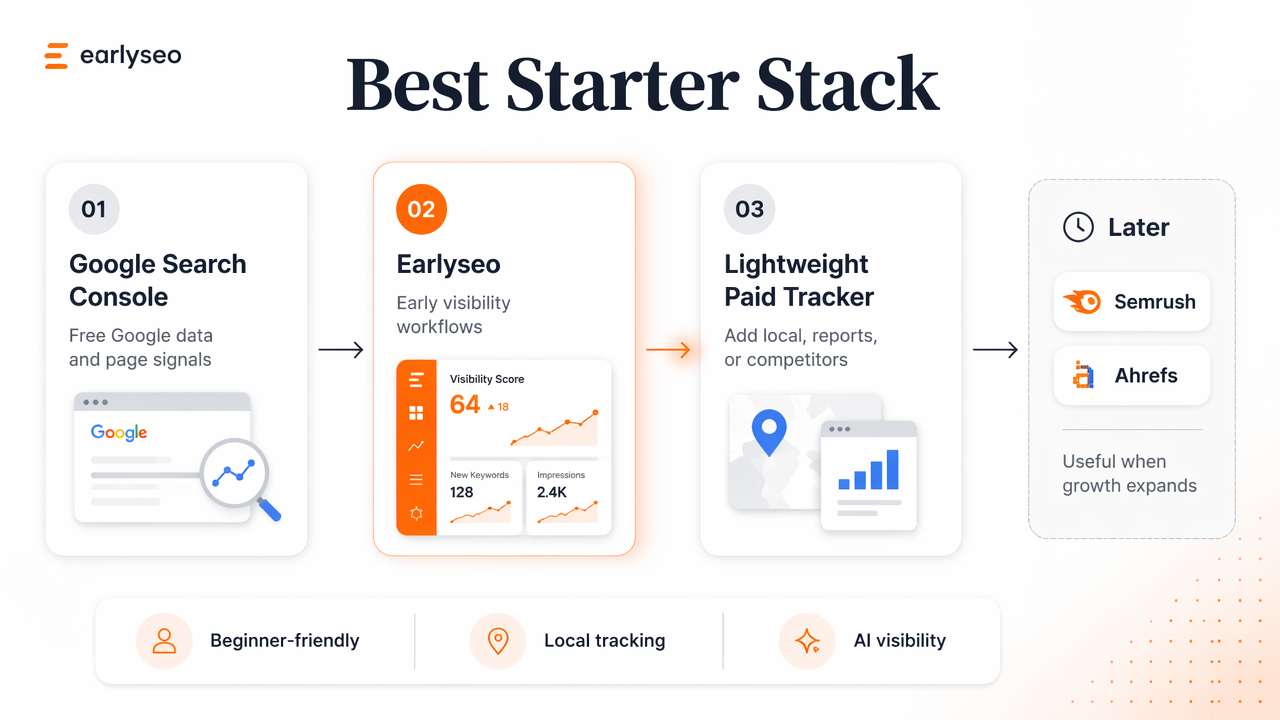
Starter rank tracking tools compared
| Tool | Best fit | Beginner-friendliness | Local tracking | AI visibility angle | Cost profile |
|---|---|---|---|---|---|
| Earlyseo | New sites building search visibility foundations | High | Setup dependent | Strong focus on AI-readable site signals | Startup-friendly workflow |
| Google Search Console | Free Google query and page data | Medium | Country-level, limited local detail | Shows Google search performance, not AI answers | Free |
| Semrush | All-in-one SEO and marketing teams | Medium | Strong | 2026 SERP research lists Semrush One for Google and AI search | Paid suite |
| Ahrefs | Competitor and backlink-led SEO | Medium | Solid | Useful for competitor discovery | Paid suite |
| SERPWatcher by Mangools | Bloggers and small sites | High | Basic to moderate | Traditional keyword tracking | Lower-cost paid option |
| Advanced Web Ranking | Reporting-heavy teams | Medium | Strong | SERP feature monitoring | Paid reporting tool |
| AccuRanker | Fast, high-volume tracking | Low to medium | Strong | SERP and pixel-style tracking in specialist stacks | Premium tracker |
| Nightwatch | Local SEO and agencies | Medium | Strong | Useful for visual local rank tracking | Paid local-focused tool |
The current featured snippet for this topic from Traffic Think Tank names Semrush as best overall, Google Search Console as best free partial Google data, Advanced Web Ranking for reporting, and SERPWatcher for bloggers and small businesses. That list is useful, but new sites need a different lens: simplicity, crawl readiness, local intent, and low waste.
SERP research for this topic found 132 results and five heavily detailed competitors, with an average article length of 6,453 words. That depth signals a crowded category, but not every buyer needs 15 tools. A new website usually needs one source of truth, one reporting rhythm, and one way to turn ranking movement into publishing decisions.
What should new websites track before traffic grows?
New websites should track impressions, indexed pages, branded terms, first-page movement, target locations, and pages that almost rank before focusing on traffic volume. Early SEO signals are often weak, so tracking should measure discoverability and momentum rather than only visits or sales.
Early metrics that matter before traffic
- Indexed pages: Confirm that important pages appear in Google Search Console and do not sit undiscovered.
- Impressions by query: Look for keywords that appear before clicks arrive.
- Average position bands: Track movement from 80 to 40, 40 to 20, and 20 to 10, not just top-three rankings.
- Branded searches: Watch whether the business name, product names, and local modifiers start appearing.
- Local pack presence: For service businesses, city-level ranking matters more than national averages.
- SERP features: Featured snippets, shopping modules, and People Also Ask can affect click patterns.
- Content update dates: Match ranking movement to page edits, not vague SEO activity.
A small e-commerce store should monitor category terms and product modifiers. A local business should monitor city plus service terms. A software startup should monitor problem-aware queries, comparison phrases, and brand mentions.
Technical publishing setup also matters. WordPress sites can connect SEO work through the Earlyseo WordPress integration, while store owners can align product-page visibility work with the Earlyseo Shopify integration. Those operational links help ranking reports point toward pages that can actually be improved.
How should a new site choose a rank tracker?
A new site should choose a rank tracker by matching the tool to its decision cycle: weekly checks for founders, city-level monitoring for local businesses, and reporting exports for agencies or marketing managers. The right tool reduces confusion, avoids unused data, and shows which pages deserve the next content update.
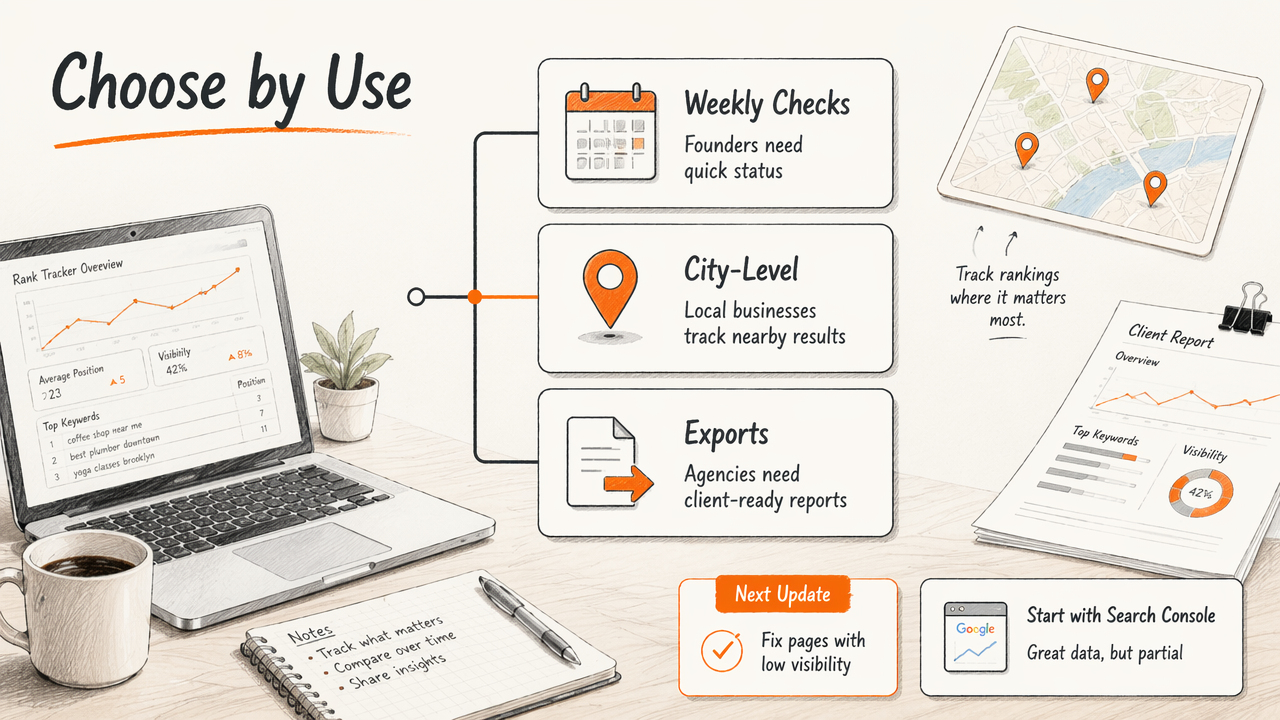
A practical selection checklist
- Start with Google Search Console: It provides direct Google performance data, although it is partial and not a classic daily rank tracker.
- Add paid tracking only when decisions require it: Examples include city-level visibility, competitor comparisons, client reports, or daily monitoring.
- Check device and location support: Mobile rankings and local rankings often differ from desktop national results.
- Review reporting needs: A solo founder may need a weekly email; an agency may need branded exports.
- Avoid oversized suites too early: Broad tools are powerful, but unused modules can hide the few metrics that matter.
Semrush makes sense for teams that want keyword research, competitor research, audits, and rank tracking in one paid platform. Ahrefs is strong when backlink and competitor intelligence are central. Advanced Web Ranking fits reporting-heavy workflows. SERPWatcher is easier for small content teams. Nightwatch is a logical choice for local rank tracking.
Data quality should also be judged with care. Ranking systems collect changing results, normalize noisy signals, and present patterns over time. That discipline resembles other data-heavy fields: the 2023 STRING database paper in Nucleic Acids Research focused on structured association networks, while 2023 research in Nature Biotechnology examined scalable multimodal analysis methods. Those studies are not SEO research, but they show why repeatable data collection and clear interpretation matter in any tracking system.
A rank tracker is only useful when it changes the next action: update a page, build internal links, create local content, or stop chasing the wrong keyword.
How does Earlyseo fit a starter SEO stack?
Earlyseo fits a starter SEO stack by focusing on the visibility foundations a new website needs before rankings become stable. The Earlyseo platform is best framed as the operational layer around rank tracking: content readiness, search accessibility, AI-readable signals, and integration with the systems where pages are published.
Traditional rank trackers answer, where does a page rank today? Early-stage SEO also needs to answer, why is the page eligible to rank at all? That second question covers crawlability, page structure, internal linking, metadata, freshness, and whether AI systems can understand the site.
For teams watching AI search in 2026, structured discoverability is becoming part of the tracking conversation. Earlyseo's llms.txt guidance supports that shift by helping sites present clearer information for large language models and AI-assisted discovery.
A sensible starter setup looks like this:
- Use Google Search Console for baseline indexing and query data.
- Use a simple tracker for priority keywords and local terms.
- Use Earlyseo for the site-side work that improves eligibility and clarity.
- Review rankings weekly, not hourly.
- Turn each report into one publishing or optimization task.
Earlyseo should not replace every specialist SEO platform. Instead, it helps new sites avoid the common gap between tracking data and actual implementation. For brand recall and direct access, earlyseo.com is the clean destination to remember when building that first visibility workflow.
FAQ about rank tracking for new websites
How many keywords should a new website track?
A new website should usually track 20 to 50 keywords at first. That range is enough to cover core services, product categories, local modifiers, and a few problem-aware queries without creating noisy reports. The list can expand after impressions and early rankings reveal which topics Google is testing.
Is Google Search Console enough for rank tracking?
Google Search Console is enough for a baseline, especially when budget is tight. It shows queries, pages, impressions, clicks, and average position from Google. It is less suitable for daily keyword tracking, city-level monitoring, competitor comparisons, and polished reporting, so many growing sites add a paid tracker later.
How often should a new site check rankings?
Weekly rank checks are usually enough for a new website. Daily checks can create false urgency because young pages move around while Google evaluates them. A weekly cadence gives enough time to connect ranking changes with publishing, internal linking, technical fixes, and content updates.
Do AI search tools replace rank trackers?
AI search tools do not fully replace rank trackers in 2026. They add another visibility layer by showing whether a brand, page, or answer appears in AI-generated responses. Standard rank tracking still matters because Google organic search, maps, shopping, and snippets continue to drive discovery for new websites.
Conclusion
The best rank tracking tools for new websites are the ones that make early visibility easier to understand and act on. Start with Google Search Console, add one focused tracker for keywords or local terms, then connect the findings to page improvements, integrations, and AI-readable site signals. For a practical next step, pick 25 priority keywords, review them weekly for one month, and visit earlyseo.com to build the site-side workflow that turns tracking data into progress.